
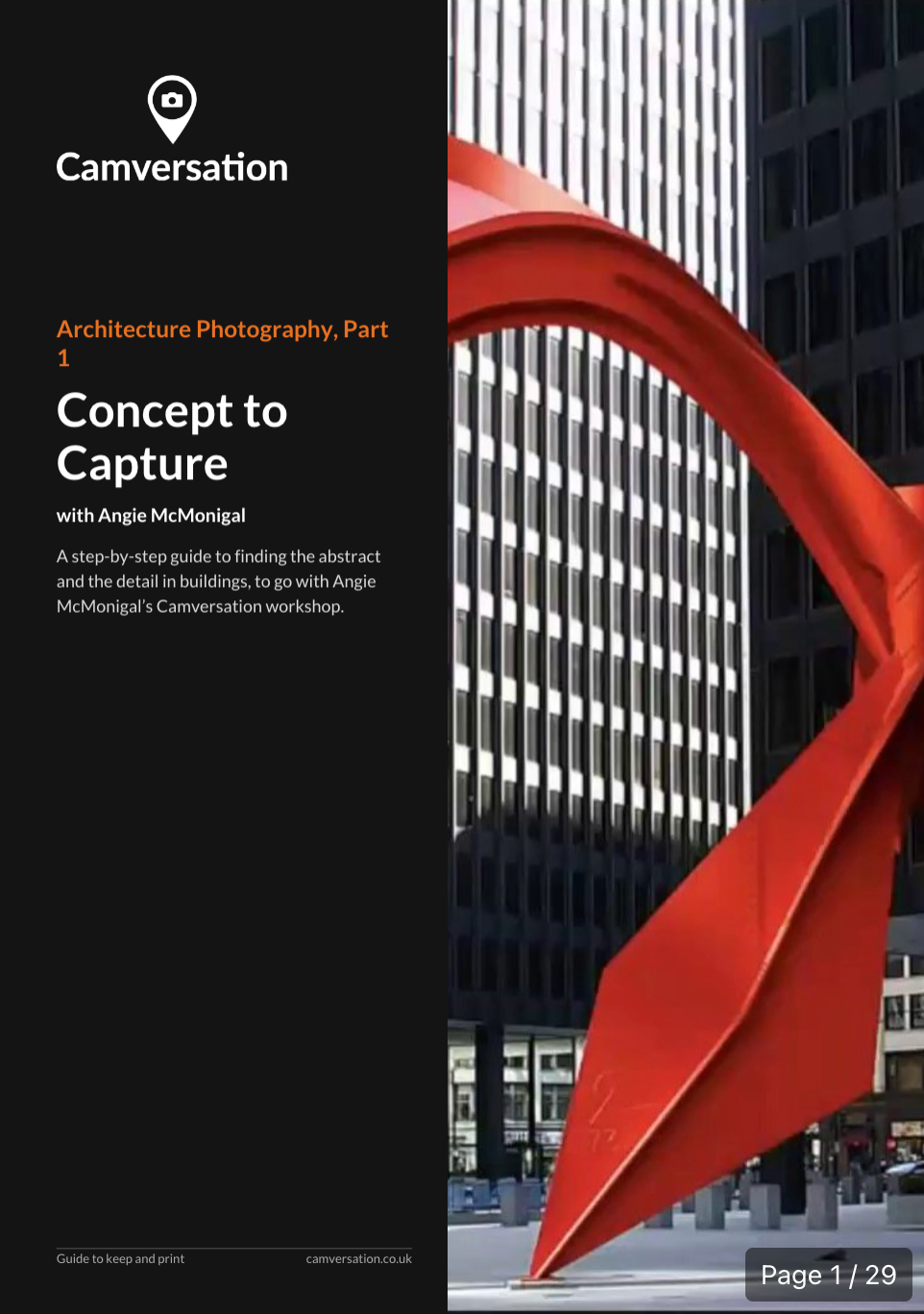
Part one of Angie McMonigal’s four-part Architecture Photography series, running live on Camversation. Three evenings are still to come, and you can join them. Details are at the bottom of this page.
You walk past the same buildings every week. Most of us photograph them the way I used to, which is to turn up, spray off a hundred and fifty frames in ten minutes and move on, then wonder later why none of them are any good.
This is a guide to doing the opposite, written from Angie’s architecture workshop and built so you can work along with it rather than just read it.
What is inside
Twenty-nine pages, eighteen steps. The steps follow the order Angie worked in, so the guide runs the way the workshop ran:
Decide which kind of picture you are making
Set the camera up so you can stop thinking about it
Expose for the highlights
Give yourself limits
Scout, and look up the architect
Spend time, and go back
Move yourself
Decide on colour or black and white
Isolate: take the building apart
Look for pattern, regular and irregular
Use negative space, or fill the frame
Push it high key or low key
Bring the surroundings in
Ask what else it is
Move the camera on purpose
Pair pictures up
Work one sculpture properly
Shoot the reflections, and go back in different light
Every step has the same four parts. What to do, as numbered instructions with the settings in bold. Why it matters, in Angie’s own words wherever she said it best. Watch out for, which is the thing that most often goes wrong. And then extra notes, one kind for anyone new to this and another for anyone who wants to push it further.
Angie’s settings, read off her own screen. Camera, lenses, mode, aperture, ISO, white balance, metering and exposure, all in one table, taken from the deck she was presenting rather than remembered afterwards.
A timestamp on every step. Each one tells you where it begins in the recording, so you can read a step, jump to that moment, watch her do it, and come back.
A glossary of twenty-two terms in plain English. Abstract, isolation, negative space, high key, low key, ICM, pareidolia, blown highlight, spot metering, focus stacking, tilt-shift, denoise and the rest. If a word in the guide is new to you, it is explained two pages in.
A kit list of seven items, each marked essential or useful, with a line on what it is for and what to know. The short version is that one camera and one zoom is enough.
Every question asked in the workshop, with Angie’s answer. Five of them, including the one everybody wants answered: what do you do when your town has no interesting buildings?
A troubleshooting page. Eight things that go wrong, each with a one-line fix that points back to the step that solves it. “Everything looks cluttered and I cannot find a picture.” “My bright areas are white with nothing in them.” “There is nothing worth photographing where I live.”
A gallery of Angie’s photographs from the workshop.
Six practice ideas to take out with you, including the one-hour exercise she suggests for when you are travelling and cannot come back.
A one-page summary to print. All eighteen steps in one line each, plus the five things worth remembering.
What people say about our guides
“A super companion piece to the talk. Very user friendly... WELL WORTH THE PRICE!” — Lynn
They are written to teach, not to summarise.
“It will make a huge difference in learning new skills.” — Fi
And they arrive in your inbox with nothing to log into.
“I appreciated having the Guide sent to my email without needing to log in or download.” — Judith
About Angie
Angie McMonigal is an architectural photographer based in Chicago. She photographs buildings the way most people photograph landscapes, looking for the small piece that carries the whole thing, and she teaches workshops in the city. Almost every picture in this guide was made in Chicago, and almost none of it depends on Chicago. As she put it at the end of the workshop, you can do this anywhere.
What you get
One PDF, emailed to you. Nothing to log into, nothing to hunt for in a portal. Yours to keep and to print.
You do not need a ticket or the recording to use the guide. It stands on its own, and if you do have the recording it will send you back to it.
The live series is still running
Angie’s Architecture Photography series runs across four evenings on Camversation, and three of them are still to come:
Part 2, Wednesday 18 November, 7pm GMT. Chaos and Order: finding balance through composition. The Fulton Center in New York, the US Embassy in London, and the Louvre.
Part 3, Wednesday 16 December, 7pm GMT. Angie editing on screen, with nothing tidied up beforehand.
Part 4, Wednesday 13 January, 7pm GMT. Members’ own photographs, looked at by Angie.
Booking now includes the recording of part one, so you would not be starting halfway through.
£24 for the four sessions. £40 adds the guides for parts one, two and three, and one of the guides is free when you order with the series. £49 adds twelve months to watch the recordings instead of four weeks, which is the one I would pick for this series, because part three is a live edit you will want to come back to after you have been out and got stuck.
Book the series →https://www.camversation.co.uk/event-details/architecture-photography-with-angie-mcmonigal-2026-11-18-19-00
If you cannot make the live evenings, that is fine. Every session is recorded and on the website within 24 hours.
